Situational analysis
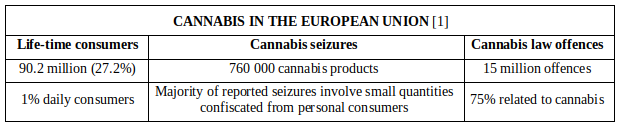
Every week, 90.2 million European citizens risk being sold a synthetic cannabis product
or cannabis contaminated with pesticide and other harmful substances.
Every day, criminal organisations continue to strengthen their market monopoly.
Every hour, 1% of European citizens risks being arrested by the police.
Rationale
The European Union Charter of Fundamental Rights underlines the importance of keeping the individual at the helm of every decision making and ensures that the universal principles of human dignity, freedom, equality, solidarity, democracy, security, sustainability, and rule of law are upheld for every European citizen. The four freedoms of the EU; free movement of people, goods and capital, and freedom of establishment, complement and strengthen the fundamental rights of the individual. Furthermore, adherence and full participation to the unifying and noble targets of sustainable development set by the UN Sustainable Developments Goals 2030, further enhance the critical nexus between justice, security, and well-being.
The EU Agenda and Action plan on drugs 2021-2025 [2] emphasises that:
“The aim of the EU Agenda on Drugs is to protect citizens through better coordinated measures that will: (i) have a substantive and measurable impact on the security and health issues arising from drug use and the operations of the drug market; and, (ii) address both the direct and indirect consequences arising from this problem including links to violence and other forms of serious crime, related health, and societal problems, environmental damage, while raising public and policy awareness on these issues“.
Furthermore, prevention and awareness, including addressing stigma are identified as key to prevent substance use and harms associated with it. The priorities also propose the introduction of wider harm reduction measures and alternatives to coercive methods.
When looking at the prevalence of cannabis consumption in the European Union standing at 27.2% and cannabis law offences amounting to 75% of all European union drug law offences (majority of reported seizures involve small quantities confiscated from personal consumers), the draconian European approach is evidently causing more harm than good. The current policy frameworks adopted by national governments, predominantly criminalising and persecuting personal consumers and cultivators, continues to propagate an environment of discrimination and injustice.
Some European Union Member States have since the early 1990s recognised that the criminalisation of the personal cultivation, consumption and sharing of cannabis is not conducive to better public health and social well-being outcomes for the community. These initiatives, together with other policy changes in the years that followed, introduced various legislative measures to address the widespread consumption of cannabis and primarily separate the personal consumer and cultivator from the criminal justice system. The shift towards a decriminalised system aims to directly disrupt the monopoly of the illicit drugs market, whilst ensuring law enforcement agents direct their attention and resources towards more pressing and violent crimes such as domestic violence, human trafficking, money laundering, and homicide.
Furthermore, it may be advisable to view regulation as a process in which revisions and corrections are not seen as failures, but pave the way for efficient regulation that promotes health policy goals. To make this possible, the necessary flexibility in implementation should be planned for from the beginning. After all, an innovation such as the regulation of the cannabis market primarily involves a social, but also legislative learning process, which is accompanied by progress and setbacks. In order to be able to continuously take into account new experiences in regulation, coordination and evaluation are cornerstones of any regulation.
Recommendations for the Members of the European Parliament and the EU Member States
Considering the core European values of defending and upholding human dignity, freedom, and equality for all European citizens, included in the European Union Charter of Fundamental Rights [3], particularly Article 7; respect for private and family life, Article 8; protection of personal data, Article 12; freedom of Assembly of Association, and Article 21; Non-discrimination;
Noting the UN International Guidelines on Human Rights and Drug Policy [4] placing human dignity and sustainable development at the centre of Member State responses to illicit drug economies;
Noting the aims and priorities of the EU Agenda on Drugs (2021-2025) particularly enhanced security measures to disrupt criminal organizations, the use of alternatives to coercive methods, and broader inclusion of harm reduction tools to educate citizens and mitigate harm originating from substance use;
Recognising the potential risks associated with driving and operating heavy machinery under the influence of psychoactive substances and the need to ensure road-side testing reflects clinically determined impairment levels [5];
Considering the high prevalence of cannabis consumption in the EU standing at 27.2% of life-time consumers and 1% of daily consumers;
Considering the large proportion of cannabis law offences amount to 75% of all drug related offences and the shocking reality that the majority of reported seizures involve small quantities confiscated for personal consumption;
Considering the current inconsistency between member state’s approach to a non-violent personal choice to consume, cultivate and share cannabis, and the various legislative changes and ongoing discussions at national level to decriminalise the personal consumption and cultivation of cannabis;
- Calls on the European Parliament to recognise the unjust and dangerous reality of criminalising a personal and private matter of consuming, cultivating, and sharing cannabis, including its derivatives and products;
- Calls on the European Parliament to honour the rights and freedoms enshrined in the EU Charter of Fundamental Rights for people who consume cannabis and promote an inclusive and regulatory framework built on human dignity, respect for private life, and social justice;
- Urges the European Parliament to take a strong stance in favour of human rights, public health, and harm reduction for all people, including people who use cannabis, and promote effective approaches to disrupt the criminal drugs market;
- Invites the European Parliament to recognise the health and social benefits of allowing self-cultivation and encourages the Member States to discuss the amount of plants allowed to grow per person for personal use;
- Invites the European Parliament to recognise the health and social benefits of Cannabis Social Clubs (CSC) and encourages the Member States to facilitate the creation of CSC [6];
- Urges the European Parliament to encourage the Member States to introduce the expungement of criminal records for non-violent and non-harming cannabis convictions and ensure any administrative sanctions adopted in the case of a breach of rights are proportionate and do not impinge on the fundamental rights of European Union citizens;
- Encourages a more active and inclusive approach with civil society organisations directly working with people who consume cannabis, including cannabis growers’ cooperatives and experts in the field of cannabis, and promote a European-wide campaign on safe, organic, and sustainable personal cultivation practices.
______________
[1] EMCDDA. (2020). European Drug Report 2020: Trends and Developments. Publications Office of the European Union: Luxembourg.
[2] European Commission. (2020). EU Agenda And Action Plan On Drugs 2021-2025. Communication from the Commission to the European Parliament, the Council, the European Economic and Social Committee and the Committee of the Regions. Brussels, 24.7.2020, Com(2020), 606 Final.
[3] European Convention. (2012). Charter of Fundamental Rights of the European Union (CFR). Official Journal of the European Union, 26.10.2012, C 326/391.
[4] United Nations. (2019). International Guidelines on Human Rights and Drug Policy.
[5]  Source: Dr. Fabian Pitter Steinmetz
[6] ENCOD. (2020). The Cannabis Social Club Guidelines.