education is not a crime

Writing about cannabis is a crime in Czech Republic!

November 15, 2021—Prague

Writing about cannabis is a crime!

On November 3, 2021, the Legalizace magazine and its editor-in-chief, Robert Veverka, were convicted of inciting and promoting “toxicomania” by the district court in the town of Bruntál.

The editor-in-chief, Robert Veverka, and the publishing company of the Legalizace magazine, both prosecuted since the summer of 2020 for allegedly inciting and promoting “toxicomania”, were given a one-year prison sentence contingent on a probationary period of two and a half years as well as a fine of 50,000 CZK by the district court in Bruntál following two court hearings.

According to the public prosecutor, Jan Žalman, Veverka and the publishing company have committed the crime of inciting and promoting toxicomania by publishing more than two hundred articles during 2010–2020 which allegedly gave the impression of cannabis processing and handling being legal, provided qualified instructions on cannabis cultivation, processing, and storage, and by publishing cannabis-themed advertisements as well as offering legal and freely marketable cannabis seeds which appeared several times as a supplement of the printed magazine issues. This conjecture was confirmed by Judge Marek Stach in his verdict on November 3, 2021, when he found the defendants guilty of the above.

Although the judge admitted that the Legalizace magazine gives the impression of a very objective medium, as it provides broadscale, comprehensive information and expert opinions as well as insight into the medical aspects of cannabis, he proclaimed the reason for his verdict is that some of the articles may incite the desire in certain individuals to acquire equipment that could enable them to grow, harvest, process, and use cannabis in a way which is illegal. The judge also stated that if the printed photographs depict cannabis flowers evidently covered with resin, these images cannot, therefore, be of industrial cannabis without psychoactive properties. According to the judge, such content is a temptation to readers; almost every issue of the magazine allegedly possesses the capability of influencing the conduct of readers and inciting them to abuse addictive substances. Although the majority of the articles found in the published magazine issues are legally sound, according to Judge Marek Stach, even one single article with the potential to incite readers is enough for the Legalizace magazine to constitute the crime of inciting and promoting toxicomania.

The judge mentioned that he is not competent to assess the benefits of the current legislation, the benefits of cannabis products in healthcare, or the negative effects of cannabis use, but that he must base his verdict on the existing legislation which is binding for all. He stated that according to his judgement, Legalizace magazine evidently and factually constituted the criminal offence of inciting and promoting toxicomania. He did not take into account the legislative provisions allowing for cannabis to be handled legally in certain cases or the comprehensive and educational nature of the information published in the magazine. On the contrary, the judge expressed his doubts as to whether the individuals who granted interviews to the magazine were made aware of its content and overall message. Personally, I consider the verdict to be very biased and severely restrictive of the freedom of expression, the right to express political opinion, and the right to information,” says Robert Veverka.

The verdict is not final, the defendants are waiting for the written statement of the reasons for the court’s decision to be issued and will use this time to consider a possible appeal. The verdict has caused considerable outrage among the lay and expert public alike, which is calling on the newly appointed Chamber of Deputies to update the outdated legislation on psychoactive substances and the specific section of the law referring to the inciting and promoting of toxicomania.

If you care about freedom of the press, you are encouraged to donate to Robert Veverka’s crowdfunding transparent bank account no. 2900469065/2010
(IBAN: CZ4320100000002900469065, BIC/SWIFT: FIOBCZPPXXX –
https://ib.fio.cz/ib/transparent?a=2900469065). The funds collected will be used to cover the costs of the lawsuit and for the further fight for freedom of expression.

Media Contact:

Robert Veverka, tel. +420 773 691 561, email: robert@legalpub.cz

Website: https://magazin-legalizace.cz/, FB: https://www.facebook.com/magazinlegalizace

Robert Veverka is the publisher and editor-in-chief of Legalizace magazine, the head of the Legalizace.cz NGO, a member of the Prague Council Commission for Drug Policy Coordination, and a representative and member of the Security Commission and Education Commission of the Prague 2 municipal borough.

steam-g2fbc2ff22_1280

The cocaine-e-cigarette

A theoretical concept of a harm reduction device for current users of smokable cocaine forms

By Fabian P Steinmetz & Heino Stöver

Although there are great regional differences, smokable forms of cocaine (crack, free-base, paco, etc.) are a drug complex associated with often harmful and problematic drug use patterns. While strategies based on drug prohibition did not eradicate the consumption of smokable cocaine forms, prohibition itself led to many harmful effects, such as criminalisation, stigmatisation, unpredictable smokable cocaine forms quality and hardly any safer-use education. While there are many positive insights from heroin-assisted treatment programs with regard to heroin users, there are no comparable programs for problematic users of smokable cocaine forms. Smokable cocaine forms are challenging due to their different pharmacology and particularly their short duration leading to often many administrations per day. In this manuscript a device for a heroin-assisted treatment-like program for problematic users of smokable cocaine forms is suggested. This device is a cocaine-e-cigarette which could be prescribed to problematic users of smokable cocaine forms to reduce the risk of lung damage, exclude potentially harmful adulterants, limit intake (by formulation and/or technical settings) and also to bring users of smokable cocaine forms into the medical system to address comorbidities and risk factors, for example cardiovascular conditions, insomnia, depression, etc. This manuscript describes basic functionality and general specifications of a cocaine-e-cigarette as a medical device treating people with respective cocaine use disorder when cessation and substitution are not considered an option.

Read the full paper here.


releafmaltalogo

Malta and Cannabis: Changes on the horizon

Malta set to decriminalize up to 7 grams of cannabis and to allow the establishment of Cannabis Associations. 

In the past weeks, the Government of Malta tabled a Bill in the Maltese House of Representatives detailing a plan for a partial decriminalised system for the adult personal non-medical use of cannabis. Bill No. 241 to establish the Authority on the Responsible Use of Cannabis and to amend various laws relating to certain cannabis activities, is a bold statement in favour of a less criminalised and more humane approach. The Bill comes at an important juncture in Maltese and regional drug policy developments. In fact, Malta will be one of the first from the European family to take the lead on promoting a more humane and regulated approach to cannabis.

ReLeaf Malta has been instrumental in pushing forward a model which places the rights of people who consume cannabis at the helm of every decision and ensure no corporate takeover nibbles away personal rights and freedoms.

Principles of human rights, social equity and sustainability have been at the core of ReLeaf Malta’s message and proposed regulated framework. Collaboration with key international partners was key to ensure proposals are built on research and an evidence-based approach, prioritising humanity before profit and corporate greed. Collaboration with ENCOD, especially close consultation of the ENCOD’s European Guidelines for Cannabis Social Clubs was instrumental to create a holistic approach to allow the cultivation, consumption and sharing of cannabis in Malta.

Bill No 241, modelled, in part, on ENCOD’s proposal of a not-for-profit system collectively cultivating, consuming, and sharing cannabis, includes the following points:

Personal cultivation and consumption 

  • Persons aged 18 and over can have up to 7 grams in their possession and won’t be charged in court or face proceedings before a justice commissioner if caught. Police will no longer confiscate cannabis under 7 grams 
  • The possession of between seven and 28 grams of cannabis will be punishable with a fine of between €50 and €100, as well as proceedings before a justice commissioner 
  • Up to 4 cannabis plants will be allowed in private residences, but they must still be kept out of sight, and only up to 50 grams of dried cannabis in the residence 
  • Consumption of cannabis in public will remain illegal with the person being subjected to a fine 
  • Possibility to obtain clean police conduct for amounts decriminalised or depenalised by the new law  

Cannabis Associations operating and registered as NGOs with the Commissioner for Voluntary Organisations 

  • Adults over the age of 18 can form an NGO (Cannabis Association) to collectively cultivate and share cannabis. The Association needs to obtain a licence form the Authority on the Responsible Use of Cannabis. The Associations cannot be situated within 250 metres of a school or youth area 
  • Cannabis associations that distribute cannabis among their members will be allowed to operate as an NGO and not for profit 
  • Persons with previous criminal records cannot form an association 
  • Up to 7 grams a day can be distributed to each member with a maximum of 50 grams per month.  
  • The organisation will also be able to distribute up to 20 cannabis seeds/month to each member and cannot have more than 500 grams of the plant on their premises at any given time 
  • Cannabis is to be distributed in sealed containers, including labelling 
  • No marketing or visible signage should be included 

Whilst not promoting the use of cannabis, the Bill aims to provide increased legal safeguards for the personal consumption and cultivation of cannabis, whilst directly impact the illicit trade and monopoly of cannabis by allowing the establishment of associations providing a source of safe cannabis. The Bill should therefore also directly impact how local police handle cannabis-related offences and hopefully ensure less harassment of people who cultivate, consume and share cannabis.

Nonetheless, it is somewhat strange, that old bogus beliefs spread by ‘the war on drugs’, continue to seep in the new law and unfortunately in some areas distort the core aim of such a reform. One worrying reality is that in a way, the law still considers cannabis possession a crime, especially if the police have ‘reasonable suspicion’ of trafficking. Whilst recognising that the 50 gram/month limit allowed to be purchased from the associations is a courageous step forward (presently 3.5 grams are depenalised), better reflecting consumption levels, it is unclear why the same amount will be allowed for those cultivating up to 4 plants. Any person that cultivates cannabis will tell you that this limit is too low even for one consumer, imagine 4 residents living under the same roof and all using cannabis on a daily basis.

Another example is the complete ban on public smoking, especially for areas only frequented by adults. This is not applied for tobacco and although closed venues and other areas frequented by children prohibit the use of tobacco, in other open spaces tobacco consumption is not banned.

Recent comments by Minister Owen Bonnici have also cast doubt on how the government foresees the daily operation of the associations. In fact, he confirmed that no smoking will be allowed on the premises and people will only visit the association to purchase cannabis or seeds. This is in stark difference to what a not-for-profit social club built on harm reduction aims to achieve. In fact, the main purpose of a similar system is to provide a safe space for like-minded people to share an activity that brings them closer together and gives them the opportunity to share knowledge or seek help if experiencing problems. Most importantly, a system where people visit and stay within the association premises to consume cannabis would ensure closer dialogue between the person and the association, especially on matters pertaining to harm reduction and health. Once more the legislator continues to obfuscate the aims of a decriminalised system with the need of keeping consumers separate from each other, hidden at home, and immediately criminalised if not adhering to strict bureaucratic and unsustainable systems. In a way, this seems a step backward and makes a mockery of the basic human rights of freedom of assembly and of association.

It seems the proposed Bill has also in a mysterious way introduced a business opportunity for some, completely ignoring the fact that these associations will be operating as NGOs and on a not-for-profit basis. The requirement of sealed containers, is a very convenient way how some businesspeople, maybe already involved in the medicinal cannabis market, will make a profit out of this new system.

To oblige an NGO to pay for thousands of sealed containers to be used only once is a clear insult to our collective intelligence, to our sustainable and environmental promises, and a cheap way how commercial interests attempt to sabotage human rights and civil liberties law.

It is also a blatant reflection that cannabis is STILL considered as an illicit narcotic that needs to be sealed and kept hidden. Whilst acknowledging the importance to keep cannabis out of the reach of children, these strict measures imposed on NGOs, together with a complete ban of participation for people with a previous criminal conviction, create an unbalanced playing field from the very beginning. Ultimately, this approach seriously risks excluding those that have been so badly affected by prohibition and the current draconian laws. These provisions also risk increasing the price of cannabis (through membership fees or other means) and thus in no significant way compete with what is available and more accessible on the illicit market.

The Bill is now at its second stage. However, due to parliamentary debates related to the yearly Government Budget, discussions on the Bill have stalled before even starting. Rumors of an early election in November continue to crumble Malta’s green aspirations that the Bill will go through by Christmas. Despite these technical and political hiccups, ReLeaf Malta remains committed to ensure any legislative change continues to respect in full human rights, social equity, and sustainability.

Keeping optimistic is what has kept us going.

Now that Malta is going through this legislative and social transition, as a small but determined NGO, ReLeaf Malta continues to wave our shared green leaf, representing and championing the voice and rights of people who consume, cultivate, and share cannabis.

I want to read the full bill.


Diseño sin título

Barcelona City Council suspended the licenses of Cannabis Social Clubs

The Barcelona City Council is canceling the city’s plan that regulates the activities of cannabis social clubs here since 2016. The associations lose their municipal licenses and become private social clubs, which means that aspects such as location, health, or ventilation characteristics of this activity are no longer guaranteed. All of this is done under the pretext that the clubs are promoting the use and cultivation of cannabis, activities that these establishments have been banned from their existence.

The administrative dispute of the Supreme Court of Catalonia came to the conclusion in its Judgment 1627/2020 of June 2nd 2021 that the city council has no powers in relation to the regulation and order of these bodies because they can be prone to a crime and it is the judges who need to decide that. The Spanish Supreme Court rejected the last appeal in April this year. This decision sets a precedent for the rest of the Autonomous Communities where licenses for this activity still exist.

It requires the consistory to transform about  200 licensed CSCs into private social clubs. Then, city authorities will open a phase of intervention and control. It means that it will take a round of individualized inspections that could lead to the ordering of closures or the opening of criminal proceedings to various clubs and associations, as well as possible sanctions under criteria that are still unknown.

As impacts in the medium term, we can find the non-limitation of cannabis associations in the city and, therefore, possible overcrowding of these places without any rule on environmental, hygiene, health criteria or specific needs for their activity. This decision encourages illicit markets and opens the ban for organized crime groups, with the risk of city invasion with practices that generate different types of violence.

The new negligence of the Spanish authorities by restricting the regulatory powers of the city council encourages organized crime and the stigma of the social movement and makes it difficult to work to regulate this reality. Barcelona City Council recognizes “the need for the Activity Regulation from a public health perspective“.

Barcelona is the cradle of Cannabis Social Clubs. An internationally expanded regulatory model for cannabis that respects the rights and health of consumers and reduces their exposure to illegal markets. Social movements there have been demanding recognition for 20 years. Now is the time to take a step forward. Spain could lead the psychoactive cannabis regulation in the EU. Will the Spanish legislators have the courage to tackle this problem effectively, taking into account the civil society approach? Who knows.

To read the original post go to ConFAC.


Erec Hand & Topbud 2018-111

Recommendations for regulating the recreational use of cannabis in the European Union

TEMPLATE LETTER TO THE MEPs


Situational analysis


Every week, 90.2 million European citizens risk being sold a synthetic cannabis product
or cannabis contaminated with pesticide and other harmful substances.
Every day, criminal organisations continue to strengthen their market monopoly.
Every hour, 1% of European citizens risks being arrested by the police.


Rationale

The European Union Charter of Fundamental Rights underlines the importance of keeping the individual at the helm of every decision making and ensures that the universal principles of human dignity, freedom, equality, solidarity, democracy, security, sustainability, and rule of law are upheld for every European citizen. The four freedoms of the EU; free movement of people, goods and capital, and freedom of establishment, complement and strengthen the fundamental rights of the individual. Furthermore, adherence and full participation to the unifying and noble targets of sustainable development set by the UN Sustainable Developments Goals 2030, further enhance the critical nexus between justice, security, and well-being.

The EU Agenda and Action plan on drugs 2021-2025 [2] emphasises that:

The aim of the EU Agenda on Drugs is to protect citizens through better coordinated measures that will: (i) have a substantive and measurable impact on the security and health issues arising from drug use and the operations of the drug market; and, (ii) address both the direct and indirect consequences arising from this problem including links to violence and other forms of serious crime, related health, and societal problems, environmental damage, while raising public and policy awareness on these issues.

Furthermore, prevention and awareness, including addressing stigma are identified as key to prevent substance use and harms associated with it. The priorities also propose the introduction of wider harm reduction measures and alternatives to coercive methods.

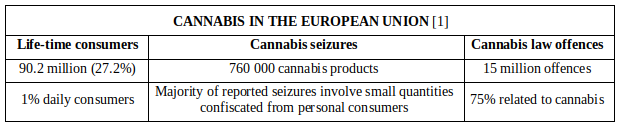
When looking at the prevalence of cannabis consumption in the European Union standing at 27.2% and cannabis law offences amounting to 75% of all European union drug law offences (majority of reported seizures involve small quantities confiscated from personal consumers), the draconian European approach is evidently causing more harm than good. The current policy frameworks adopted by national governments, predominantly criminalising and persecuting personal consumers and cultivators, continues to propagate an environment of discrimination and injustice.

Some European Union Member States have since the early 1990s recognised that the criminalisation of the personal cultivation, consumption and sharing of cannabis is not conducive to better public health and social well-being outcomes for the community. These initiatives, together with other policy changes in the years that followed, introduced various legislative measures to address the widespread consumption of cannabis and primarily separate the personal consumer and cultivator from the criminal justice system. The shift towards a decriminalised system aims to directly disrupt the monopoly of the illicit drugs market, whilst ensuring law enforcement agents direct their attention and resources towards more pressing and violent crimes such as domestic violence, human trafficking, money laundering, and homicide.

Furthermore, it may be advisable to view regulation as a process in which revisions and corrections are not seen as failures, but pave the way for efficient regulation that promotes health policy goals. To make this possible, the necessary flexibility in implementation should be planned for from the beginning. After all, an innovation such as the regulation of the cannabis market primarily involves a social, but also legislative learning process, which is accompanied by progress and setbacks. In order to be able to continuously take into account new experiences in regulation, coordination and evaluation are cornerstones of any regulation.


Recommendations for the Members of the European Parliament and the EU Member States

Considering the core European values of defending and upholding human dignity, freedom, and equality for all European citizens, included in the European Union Charter of Fundamental Rights [3], particularly Article 7; respect for private and family life, Article 8; protection of personal data, Article 12; freedom of Assembly of Association, and Article 21; Non-discrimination;

Noting the UN International Guidelines on Human Rights and Drug Policy [4] placing human dignity and sustainable development at the centre of Member State responses to illicit drug economies;

Noting the aims and priorities of the EU Agenda on Drugs (2021-2025) particularly enhanced security measures to disrupt criminal organizations, the use of alternatives to coercive methods, and broader inclusion of harm reduction tools to educate citizens and mitigate harm originating from substance use;

Recognising the potential risks associated with driving and operating heavy machinery under the influence of psychoactive substances and the need to ensure road-side testing reflects clinically determined impairment levels [5];

Considering the high prevalence of cannabis consumption in the EU standing at 27.2% of life-time consumers and 1% of daily consumers;

Considering the large proportion of cannabis law offences amount to 75% of all drug related offences and the shocking reality that the majority of reported seizures involve small quantities confiscated for personal consumption;

Considering the current inconsistency between member state’s approach to a non-violent personal choice to consume, cultivate and share cannabis, and the various legislative changes and ongoing discussions at national level to decriminalise the personal consumption and cultivation of cannabis;

  1. Calls on the European Parliament to recognise the unjust and dangerous reality of criminalising a personal and private matter of consuming, cultivating, and sharing cannabis, including its derivatives and products;
  2. Calls on the European Parliament to honour the rights and freedoms enshrined in the EU Charter of Fundamental Rights for people who consume cannabis and promote an inclusive and regulatory framework built on human dignity, respect for private life, and social justice;
  3. Urges the European Parliament to take a strong stance in favour of human rights, public health, and harm reduction for all people, including people who use cannabis, and promote effective approaches to disrupt the criminal drugs market;
  4. Invites the European Parliament to recognise the health and social benefits of allowing self-cultivation and encourages the Member States to discuss the amount of plants allowed to grow per person for personal use;
  5. Invites the European Parliament to recognise the health and social benefits of Cannabis Social Clubs (CSC) and encourages the Member States to facilitate the creation of CSC [6];
  6. Urges the European Parliament to encourage the Member States to introduce the expungement of criminal records for non-violent and non-harming cannabis convictions and ensure any administrative sanctions adopted in the case of a breach of rights are proportionate and do not impinge on the fundamental rights of European Union citizens;
  7. Encourages a more active and inclusive approach with civil society organisations directly working with people who consume cannabis, including cannabis growers’ cooperatives and experts in the field of cannabis, and promote a European-wide campaign on safe, organic, and sustainable personal cultivation practices.

______________

[1] EMCDDA. (2020). European Drug Report 2020: Trends and Developments. Publications Office of the European Union: Luxembourg.

[2] European Commission. (2020). EU Agenda And Action Plan On Drugs 2021-2025. Communication from the Commission to the European Parliament, the Council, the European Economic and Social Committee and the Committee of the Regions. Brussels, 24.7.2020, Com(2020), 606 Final.

[3] European Convention. (2012). Charter of Fundamental Rights of the European Union (CFR). Official Journal of the European Union, 26.10.2012, C 326/391.

[4] United Nations. (2019). International Guidelines on Human Rights and Drug Policy.

[5]    Source: Dr. Fabian Pitter Steinmetz

[6] ENCOD. (2020). The Cannabis Social Club Guidelines.


Erec Hand & Topbud 2018

Coming up…

Dear friends and members,

In the past two months, our team was busy organizing a conference on the recreational use of cannabis in collaboration with the Maltese MEP Cyrus Engerer and his team.

Check out the teaser for the conference below, and we hope you tune in on the 19th of April at 10.30 (CET) to watch the conference online.

More information coming soon…


cropped-logo-Cannabus-page-001-1-1

Free ‘National Cannabis Newspaper’ aims to get cannabis consumers to vote in Dutch elections

EINDHOVEN – A free ‘National Cannabis Newspaper’ will be available throughout the Netherlands from February 9 to March 17, the day of the national elections. The paper is published by the VOC, the Union for Abolition of Cannabis Prohibition. The 100.000 copies will be distributed via the 570 cannabis coffeeshops in the country.
The twenty-page newspaper is free of advertisements and contains articles, columns, an interview with Member of Parliament Vera Bergkamp, recipes, home growing tips, an English Readers Section, an overview of the political parties’ positions on cannabis and a cannabis crossword puzzle. Bergkamp says in the interview: “It is now tolerated that people grow five plants. I would like to see that this is no longer punishable at all. This point is still on my to-do list.”

Golden Tickets

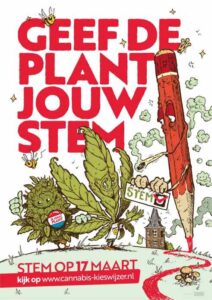
Seven of the hundred thousand copies of “De Nationale Cannabis Krant” contain a Golden Ticket. The lucky finders get to spend an unforgettable cannabis day in Amsterdam, including a visit to the Cannabis College, the Hash, Marijuana & Hemp Museum and various coffeeshops, a private canal tour and a VIP dinner with special guests. Participation is limited to persons aged 18 and older. The VOC foundation, established in 2009 to speed up legalization of cannabis in the Netherlands, cooperates with the “Maatschappij en Cannabis” foundation, creators of the “Cannabis-Kieswijzer” and the new “Cannabis-Stemwijzer”, and with the national coffeeshop unions PCN and BCD. The paper will be available for free at cannabis coffeeshops from February 9, the website www.denationalecannabiskrant.nl contains a PDF and additional information. Cannabis-friendly voting With “De Nationale Cannabis Krant”, the VOC tries to get the negative effects of cannabis prohibition higher on the political agenda and to get as many cannabis consumers as possible to vote cannabis-friendly in the elections. The center pages feature an election poster, designed by Amsterdam based artist Mossy Giant. The slogan “Geef de plant jouw stem” translates as “Give your vote to the plant”.
In the first week of March, all 570 Dutch cannabis coffeeshops will receive a campaign package in the mail, containing election posters, campaign vests for staff, filter tips and eighty copies of “De Nationale Cannabis Krant”. From February 9 the paper will be available at 24 distribution points in eleven of the twelve Dutch provinces, listed on the back page.

Website VOC foundation: www.voc-nederland.org | Twitter: @vocnederland
Website De Nationale Cannabis Krant: www.denationalecannabiskrant.nl

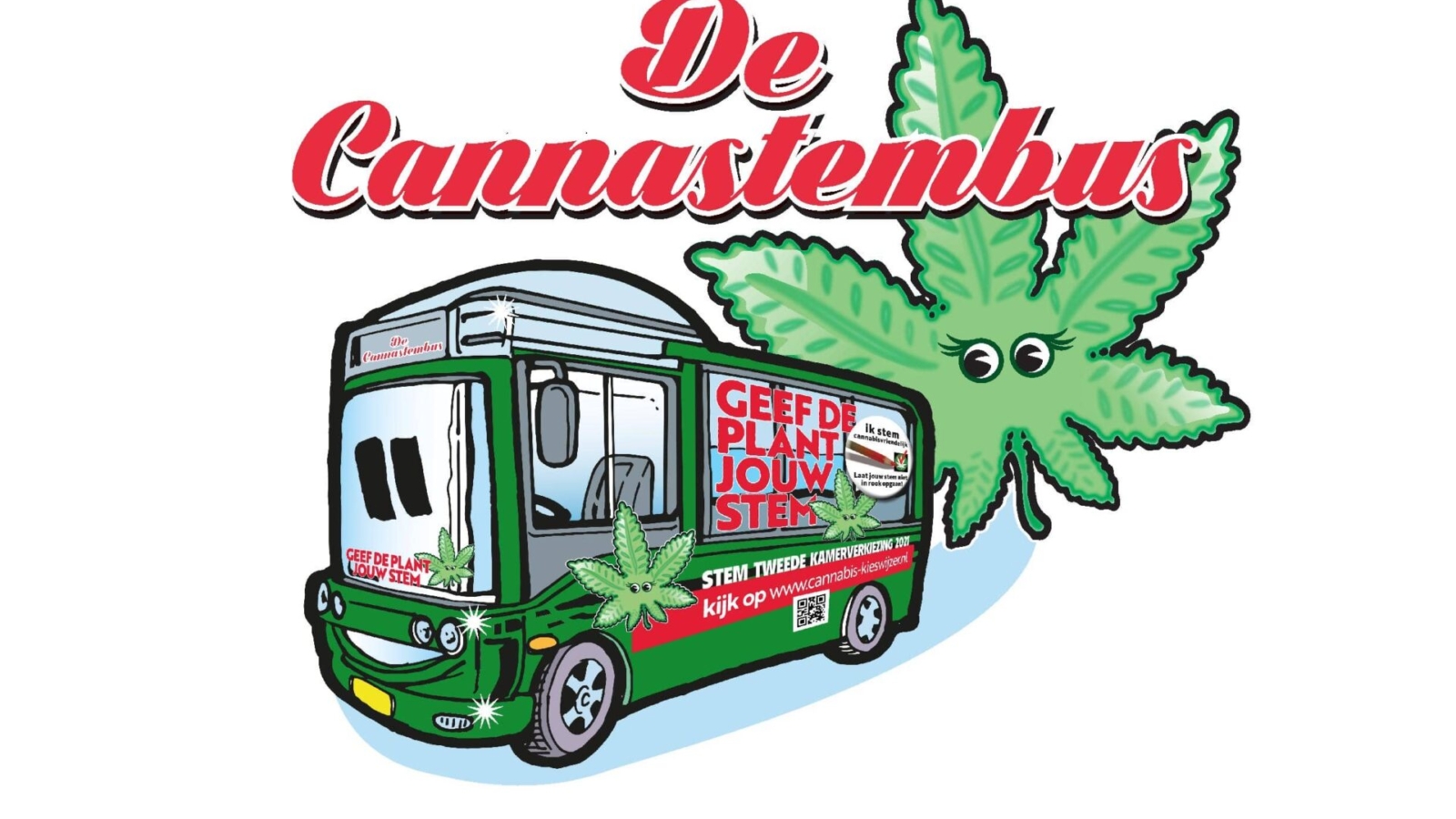
Website of the CannaStemBus: https://cannastembus.nl/

Check out the cannabis friendly voting assisting websites:


Screenshot_2021-02-25 Unhappy Birthday

The 100th anniversary of the Belgian “drug law”

The Belgian drug law is 100 years old. For that long, it has been there as a legal basis to stigmatise and punish people who use drugs. For that long, this law has had a negative impact on public health and human rights.

Now that this experiment has been going on for literally a century without producing any significant results, we are ready for a critical evaluation of Belgian drug policy.

The campaign Unhappy Birthday is an action of the civil movements SMART on Drugs and #STOP1921. This initiative advocates the decriminalisation of the possession of all illegal substances for personal use and the establishment of a parliamentary working group to review the drug policy with a human approach.

Check out the webpage of the campaign Unhappy Birthday.


skksao

Social Cannabis Club SKK Sombor

The citizens’ association “Social Cannabis Club SKK Sombor” is a humanitarian, non-governmental and non-profit association. We were renewed in 2015, and we officially registered in January 2016. Previously, there was a bar at this location and people with open attitudes and opinions came, and for these reasons, this association was formed.
From 2015 until today, we had many lectures and presentations about cannabis, people who are treated with cannabis gathered, and those who would like to be treated, we had TV shows, guests from the field of cannabis came to us and we participated in various festivals.
We hope that cannabis will be legalized soon.


Suomen kannabisyhdistys: Finnish Cannabis Association

SKY, The Finnish Cannabis Association, has been founded in 1991 in order to influence drug policy in a way that cannabis cultivation and possession are permitted for adults and production and distribution become regulated.
As a veteran organization, it has a long experience with public appearances like the Wind Direction Action in 2020, an installation that showcased flags of countries that have already taken at least the first steps to a more reasonable drug policy.
Like many groups of civil society SKY suffered from a serious lack of funding, people stopped being interested when legalization did not happen instantly. But with a recent action SKY managed to regain attention, bringing an increase in membership, especially young people who have joined to strengthen their ranks.
SKY has initiated a successful citizens initiative to decriminalize cannabis use, for which they gathered 60.000 signatures. The initiative would stop punishing for using cannabis, allow a person to possess 25 grams, and grow 3 plants.
It was presented to Finland’s parliament on November 5th 2020, it is receiving a lot of media coverage and has reinvigorated the discussion within society. There will be a law committee hearing about the initiative on February 17th 2021. For updates and developments on the citizen’s initiative click here.
SKY is a long-standing member of ENCOD.

Sky.org